


Blog / Enterprise


One topic you can expect to hear about in this year’s Upfronts and beyond is full-funnel or performance TV. Most advertisers understand the value of CTV in driving outcomes. With CTV ad spending projected to grow 15% to $37.19 billion this year,¹ it's no surprise that brands are looking to prove impact across the funnel.
We understand the “why.” The question now is the “how.” How can a channel traditionally seen as upper-funnel deliver across the full customer journey? The answer lies in maximizing the impact of each funnel stage. Every touchpoint moves the customer forward, and with the right approach, CTV can nurture audiences from impression all the way to conversion.
To guide customers across the funnel, brands need a persistent way to connect touchpoints and understand where someone is at in their journey. That starts with identity. Yahoo DSP can confidently reach over 90% of U.S. CTV households² through our deterministic identity graph anchored in Yahoo ConnectID. This creates a more accurate household view than IP-based methods, which are less stable, giving advertisers:
The proof of identity’s value on CTV is in the performance. For example, NBCUniversal found that integrating Yahoo ConnectID produces better outcomes. When Yahoo ConnectID-enabled inventory was compared with inventory without it, the results were clear for Peacock advertisers:
This identity foundation is what makes it possible to execute true full-funnel CTV — not just upper-funnel impressions, but measurable outcomes tied back to households.
When people talk about “full-funnel,” the conversation often jumps straight to outcomes. But a true end-to-end strategy starts earlier, reaching the right customers at scale from the beginning.
Predictive Audiences, tuned specifically for CTV, is a smart place to start. Rather than relying only on past behavior, predictive models can help advertisers identify consumers with a higher likelihood to engage, visit, or convert, balancing scale with efficiency from the outset.
Then it’s about setting the right optimization goals. The Yahoo DSP Reach goal is not your standard reach goal; it leverages our foundation of identity to provide:
To demonstrate the efficacy of the Reach goal, we compared two campaigns: one without an optimization goal and one using the Reach goal, with all other variables held constant. What we saw with Reach vs. no optimization⁵
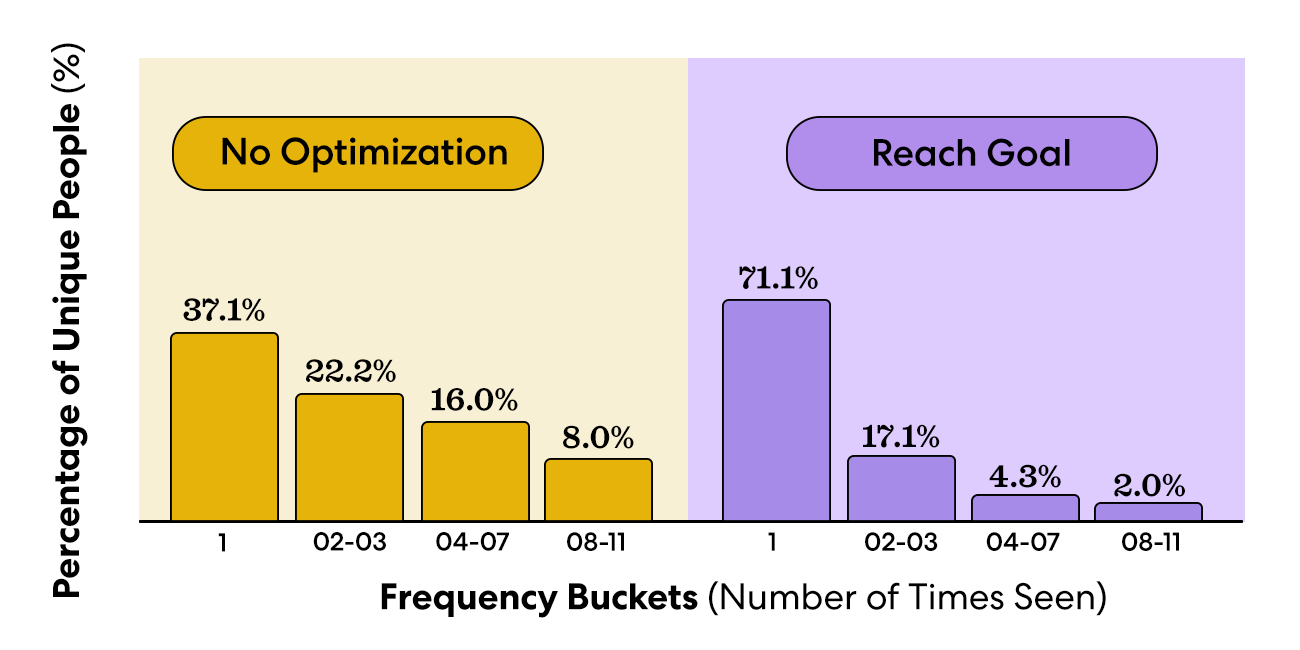
That kind of distribution matters. In CTV, full-funnel success doesn’t start with maximizing impressions against the same viewer; it starts with reaching the right households efficiently, then managing frequency so the campaign can work harder across the journey.
If your focus is on the bottom of the funnel, performance is really about optimizing to ROAS.
With ROAS optimization, advertisers can assign different values to different conversion events, maximize returns, and improve cost efficiency. That makes it possible to optimize not just toward volume, but toward the outcomes that matter most to the business, whether that’s purchases, obtaining higher-value customers, or more profitable actions.
What’s even more powerful is that with Reach and ROAS, advertisers don’t have to choose. With the Yahoo DSP Multiple KPI Optimization, Reach can serve as a secondary goal alongside a primary performance goal like ROAS, helping advertisers preserve breadth while still optimizing toward conversion value.
As CTV continues to mature, advertisers need strategies built for both scale and outcomes to meet customers where they are in their journey. That means using the right tools to reach the right households, manage frequency, and optimize toward the results that matter most.
Sources:
1. eMarketer, Feb 2026
2. Internal Yahoo DSP data, Q1 2026
3-4. Internal Yahoo DSP data, Q2 2025
5. Internal Yahoo DSP data, Q1 2026
--
About Kavisha Doshi
Kavisha Doshi is a senior product manager at Yahoo DSP with expertise in machine learning, optimization models and advertising technology

.jpg)