

The 30-Year Head Start:
How the Strength of Yahoo’s Data Fast-Tracked Yahoo Scout
The bar for launching a new AI answer platform is incredibly high. With sophisticated products like Gemini and ChatGPT already on the market, it could take many companies years to build an experience that meets user expectations. But the team behind Yahoo Scout had a unique advantage: the scale of Yahoo’s data and the proprietary search architecture built to handle it.
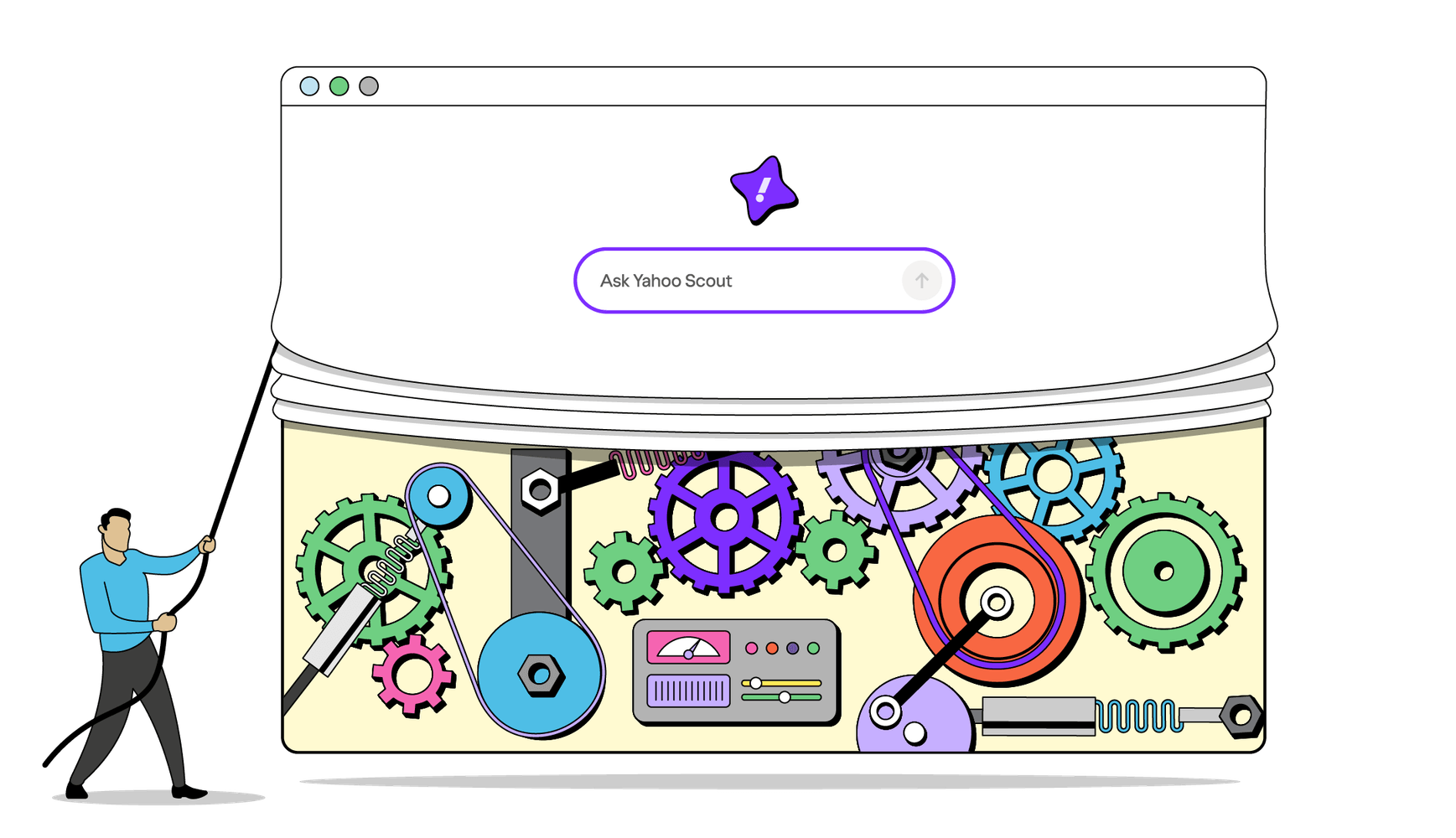
Yahoo Scout, a new AI answer engine currently in beta, was built on a foundation three decades in the making. While startups often spend months on data acquisition and infrastructure, the Yahoo Scout team got a major head start from Yahoo’s existing tech stack, using proven, advanced components already operating at a global scale.
"A key principle of Yahoo Scout is giving users the best of Yahoo," says Eric Feng, Senior Vice President and General Manager of Yahoo Research Group. "Yahoo is a top 3 internet leader in News, Sports, Finance, and Search and we brought highlights from all those products to Scout. In addition to data and information, we also benefited from the designs, expertise, and user experiences from the Yahoo portfolio. Why create a new stock chart when Yahoo Finance already has one of the best stock charts in the world?"
.png)
The search architecture provided a moat
The intelligence of Yahoo Scout is anchored in internal search technology forged from three decades of operating one of the largest search products on the internet. By drawing from Yahoo’s established query understanding system, content ranking system, and a proprietary knowledge graph, Yahoo Scout can both identify the specific intent behind a user’s question and then organize the information to answer that question in an order that’s easy to understand.
When a user asks, "Why is Lucid Group stock moving today?", Yahoo Scout refines the request into multiple specialized searches that are sent across the entire Yahoo network. This retrieval pulls in reputable data—including live stock prices, company facts, related news, and authoritative publishers from Microsoft's Bing web index—to provide the critical context necessary for a tailored response.
Yahoo Scout then creates a custom answer in real time based on all these sources with the help of Anthropic’s Haiku foundational model, selected for the speed and safety guardrails required at Yahoo’s scale. Finally, the generated answer is combined with visual elements like charts, tables, maps, and images and dynamically rendered into a readable layout for the user, informed by Yahoo’s editorial expertise in content presentation.
“When our users ask us sophisticated questions, they expect sophisticated answers in return,” says Byron Jourdan, Vice President of Product Management, for Yahoo Research Group. “Our support of the open web, from our history of being both a search engine and a news publisher, is so important in creating answers that users can understand and trust.”
The team used AI to develop prototypes
While the data and infrastructure provided a strategic head start, the team used AI to solve a classic development bottleneck: the slow handoff between design and engineering. They moved beyond mere vibe coding into a more sophisticated, AI-accelerated development process that favored interactive prototypes over static mocks. Bridging that gap meant blurring the traditional lines between roles. One designer prolific in code commits became known as the team’s “design engineer,” while an engineer with a great eye for usability became the “engineering designer.”
One designer prolific in code commits became known as the team’s “design engineer,” while an engineer with a great eye for usability became the “engineering designer.”
The team used AI tools to rapidly build functional interfaces and animations so everyone at all times could experience how features would look and work. This allowed the company's executive leadership to see for themselves how Yahoo Scout would behave in the real world—from entity extraction to real-time news summaries—before the product was live, which accelerated feedback and decision-making.
"Instead of trying to explain what we wanted to create, we could just show people an interactive prototype and let them try it themselves," says Nico Matson, Director of Design, Yahoo Research Group. "This helped us move quickly from idea to implementation."
Global team work was an accelerant
A final key to the build was the way Feng’s team worked together with teams spread across the globe. While legacy companies often view distributed teams as a logistical hurdle, Yahoo Scout turned it into an advantage.
With team members spread from the U.S. West Coast to the United Kingdom to the Middle East, the product was effectively being improved around the clock. The asynchronous nature of the operation became an accelerant.
"You would see folks checking in throughout the day to help out," says Rob Post, Vice President of Engineering, for Yahoo Research Group. "An engineer in San Francisco might push a code fix before they go to bed, and someone in London would be able to immediately review and approve it given it was now their morning. The product was truly evolving around the clock.”
When you pair three decades of data and insights with powerful AI tools and the agency to move fast around the world, the result isn't just a new product—it’s a new pace for innovation. And with Yahoo Scout, that pace continues. Less than two months after the beta launch, the team introduced MyScout, the first personalized homepage for AI answers.
Yahoo Scout will continue to improve and evolve in the months ahead, expanding to power new AI experiences across the entire Yahoo portfolio, all created with small, focused, and distributed teams. “Yahoo Scout is an opportunity for us to not only ship new products to help our users, but also ship new processes to help our builders,” Feng said.
Try it today at scout.com and in the Yahoo Search app on iOS and Android.