

Product Designer or Engineer? AI Is Blurring the Lines
It's where great product ideas often stall: the handoff between design and engineering. A designer creates a static vision for a feature, steps aside, and then waits for an engineer to manually turn it into working code. But one day last year, a small team working on a new product at Yahoo discovered that they could streamline that traditional operating model.
Nick Lockington, Principal Product Designer at Yahoo, used AI to move beyond static mockups, crafting the high-level logic for a feature himself. By putting his prompt directly into Google’s Vertex AI and requesting a JSON output, the team bypassed the traditional build phase entirely.
“It was a total ‘aha’ moment,” says David Grandinetti, Distinguished Software Apps Engineer at Yahoo. “Nick became immediately the most leveraged engineer on our team, because he was working at the highest level of abstraction.”
Much has been said about how AI is changing the role of engineers, as tools such as Claude Code handle more of the manual coding. But for the most AI-forward teams, it is also redefining what a product designer can be – and, by extension, how designers, engineers, and product managers can collaborate.
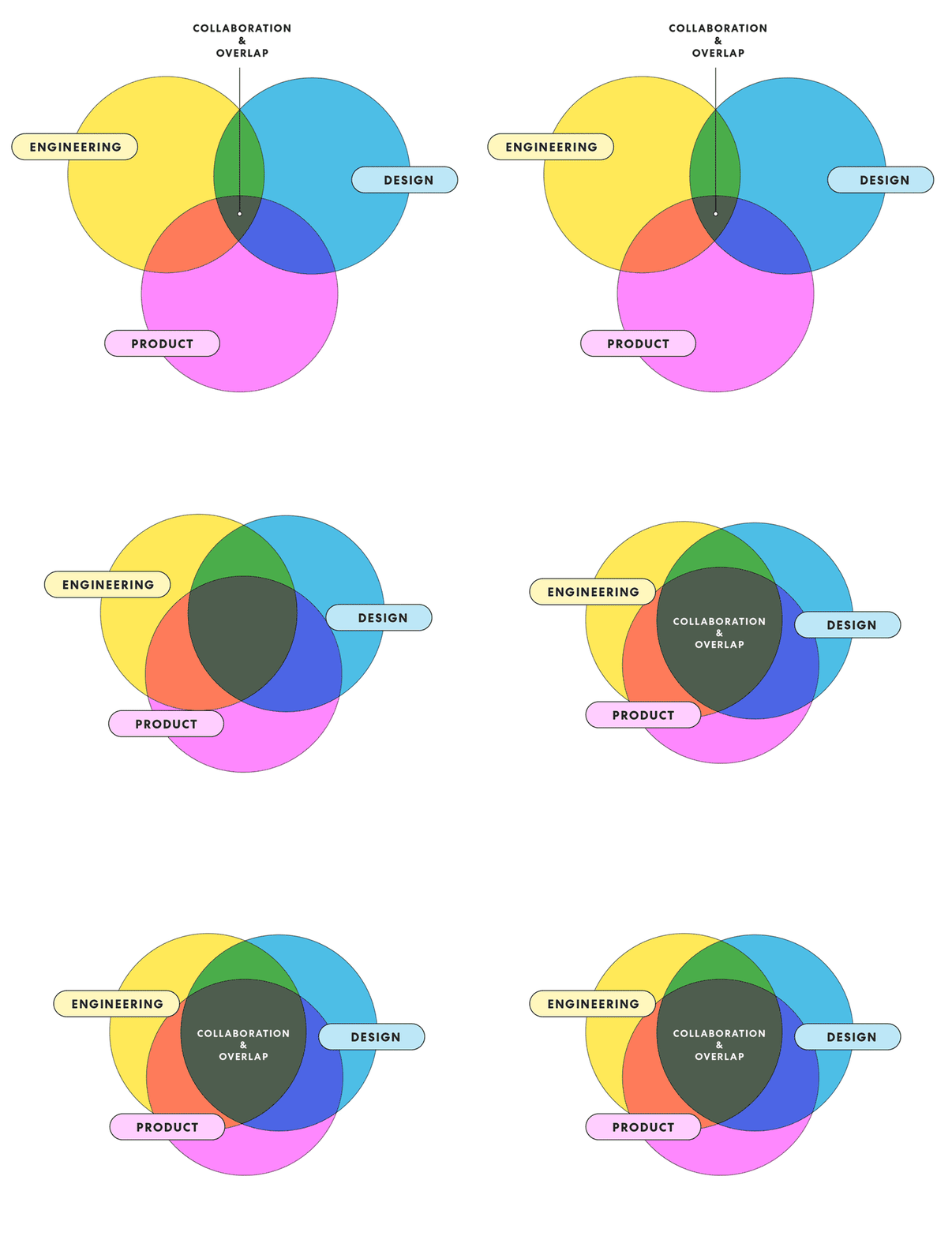
The product team of the past was made up of specialists who stayed in clearly defined lanes. Product managers dictated the strategy, designers drew the static interfaces, and engineers built the logic to power them. Product teams at the vanguard of AI-powered development are blurring those roles. They are granting individuals the autonomy to build and iterate on their own, while demanding much tighter strategic alignment to ensure the whole squad is accelerating in the same direction.
On the team that built Yahoo Scout, a new AI answer engine currently in beta, one designer prolific in code commits became known as the team’s “design engineer.” An engineer with a great eye for usability became the “engineering designer.”
"This is about increasing decision velocity and cutting the cost of experimentation, so teams can test a hundred ideas instead of five and quickly discard failures without the traditional burden of technical debt," says Stephane Koenig, Vice President at Yahoo. "It allows us to reserve human expertise for the hardest decisions where you need context AI doesn't have."
This is about increasing decision velocity and cutting the cost of experimentation.
From drawing maps to building engines
Lockington entered product design because he wanted to create things that solved real problems for people. He has worked on airline and weather platforms, news and social media interfaces, and more recently, the Yahoo Creators program. “You’re not just selling things, you’re making something that can be really useful. I found that very rewarding,” he says. But throughout his career, the traditional silos often served as a barrier to the very impact he wanted to have.
The traditional process assumed that building was expensive and slow, necessitating meticulous sign-offs on product requirement documents and designs to limit the cost of a mistake. This forced specialists like Lockington into rigid lanes, where a designer has to wait for an engineer to build the engine just to see if an idea works. In that gap, the feedback loop breaks: ideas lose momentum in the handoff, and teams are forced to make major technical decisions before they even know if they are building the right thing.
AI changed that dynamic. By using it to generate functional logic prompts, Lockington realized he could build the brains of a feature himself. An engineer on his team noted that he had essentially created a functional API through prompting. This shift moved him from drawing static maps to building functional prototypes that do the whole thing, allowing the team to validate ideas in hours rather than weeks.
Engineers remain the final arbiters of code safety. Lockington still pairs with them to review complex logic, and the team has implemented guardrails, such as bots that review pull requests and provide feedback. The bots can even suggest specific engineers for review – but Lockington no longer strictly depends on them to bring an idea to life.
“Working like this democratizes the process,” Lockington says. “If we have to go down the wrong road, it’s no longer a disaster, because we can build and validate ideas so quickly. AI makes these ‘build-learn-update’ cycles real, allowing us to move at the speed of a product mindset rather than a technical limitation.”
The new constraint: decision velocity
With that technical leap, though, comes a very human problem: overlapping roles can be uncomfortable. That is true whether you’re moving out of your comfort zone or whether someone on your team is moving into yours. Lockington credits the psychological safety within his team, led by Koenig, with helping them transition to new ways of working.
"Traditionally, you might have someone ask, ‘Why is this engineer doing design work?’ or ‘Why is this designer doing my job?’" Lockington says. "We’ve been able to break that down."
This high-speed autonomy also demands a new kind of discipline. Because tasks that once took weeks can now be finished in minutes, the bottleneck is no longer the technical labor of building, but the relentless demand for human decision-making. The team can often build features faster than it can decide what to build next.
This acceleration means that success in this environment depends less on a specific technical background and more on an individual's resourcefulness and willingness to embrace the unknown. As technical barriers fall, the new constraint for the organization becomes the speed and quality of its choices.
“The thing that will restrain us isn't the technology,” Koenig says. “It's really how fast we can make decisions.”
Key takeaways
Redefine roles by judgment. Roles should no longer be defined by what a person can manually produce, but rather the expertise they uniquely bring and the decisions they ultimately own. As a designer, Lockington is the arbiter of user behavior and aesthetic excellence – just as engineers remain the arbiters of architecture, code safety, and structural integrity.
Build the workflow into the code. By merging task management and quality reviews into a single, code-connected layer (using tools like GitHub Issues or Linear), AI agents can absorb the team's operational logistics. Leaders can pull project status agentically from codebase summaries and shift code reviews away from raw syntax toward auditing the actual human-AI conversation transcripts to evaluate strategic intent.
Govern individual decision capacity. To prevent systemic decision fatigue, leaders should intentionally limit the number of active projects assigned to any one person. Just because AI allows an individual to technically span multiple codebases does not mean their cognitive capacity can handle the accompanying flood of choices. True scale requires building smaller, focused squads rather than letting a single team split its focus.