

Inside Yahoo’s Historic, 500-Petabyte Cloud Migration
For years, product managers at Yahoo Mail faced a frustrating reality: if an idea for a new feature required a backend adjustment, they might as well not even bother with it. The architecture was too rigid, with all data stored in legacy, on-premises servers, and modifying it would take too long. Something seemingly simple like a new inbox tab could take up to two years to ship.
To equip its builders to move at the speed AI demands, Yahoo has quietly been making one of the largest data migrations the technology industry has ever seen. The company is in the process of moving 500 petabytes of email infrastructure and platform workloads to Google Cloud, all while continuing to ship new features and app experiences.
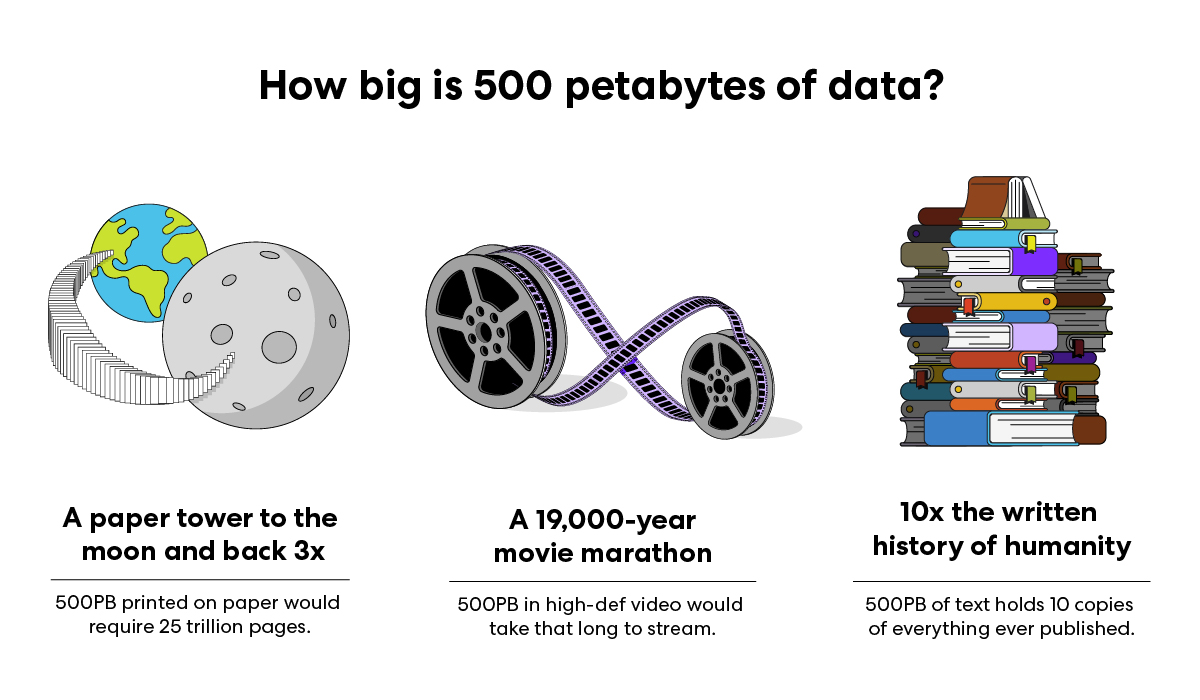
To put that in perspective, if you printed 500 petabytes of data on paper, you'd need approximately 25 trillion pages. Now imagine moving all of those pages from one mega-library to another, all while hundreds of millions of people continue to read them.
The migration has required not just a transfer of information but joint innovation between the two companies to pull it off smoothly. And it is already transforming Yahoo's operational efficiency, unlocking significant cost savings and a dramatic reallocation of human capital. Before, a substantial amount of Mail engineers' time was sucked up by basic data center maintenance, like swapping failed hardware and manual server patching. Now, those tasks are being offloaded to Google Cloud, meaning more time for building, testing, and shipping products.
"Testing and launching features at our scale used to mean constantly battling infrastructure bottlenecks and competing for server space," says Matt Sanchez, COO of Yahoo. "The cloud removes that physical drag. Our teams can now simulate massive user activity instantly, spot issues early, and iterate in minutes. That shift has fundamentally changed our execution model, moving us away from managing legacy constraints and freeing the organization to operate at the speed of the market."
Ditching the waterfall for real-time agility
What's unusual about this data migration is not only the sheer size. It is also how Yahoo went about it. The typical playbook for a big enterprise is to hire a vendor to spend months developing a rigid, multi-year migration plan and then stick to it. The problem with that approach is that it's harder to adapt as unexpected glitches emerge. At Yahoo's scale, with a core architecture that has evolved over three decades, predictability is an illusion.
Instead, Yahoo partnered with Google Cloud to co-develop a new cloud architecture, upskilling internal teams so they could independently operate and scale the infrastructure for the long haul. To pressure-test this new framework safely, the teams co-designed stability checks and simulated full regional system failures. They also collaborated to configure the cloud architecture, achieving strong global consistency while matching the single-digit millisecond latency of Yahoo’s legacy systems. This joint effort allowed Yahoo to avoid legacy hardware delays and dismantle on-prem data silos.
“As opposed to trying from the very beginning to waterfall-plan out every single thing we're going to do and execute on this giant, multi-year plan, we took a more agile approach,” says Yahoo CTO Lee Zen. “We had a good idea of what the plan looked like. But no plan can completely account for every technical variable or how a new platform will behave at our scale. As we started executing the plan, lots of things changed but at every step of the way, we worked together to figure it out. That continues to this day.”
Powering the AI inbox mid-flight
Shipping new features in the middle of a massive migration is a high-wire act where the margin for error is virtually zero. When modernizing three decades of legacy infrastructure, backend data work is so sensitive that a single mistake carries the risk of making applications unusable or permanently losing decades of data.
In a traditional migration, enterprise leaders often delay major product upgrades, but Yahoo refused to make that tradeoff. “We don’t want the migration to limit our ability to innovate while it’s happening,” says Kyle Miller, General Manager of Yahoo Mail. “It’s not a choice between modernizing our massive data foundation or delivering incredible new user experiences—we have to do both simultaneously.”
Achieving that balance required breaking an old operational habit. In legacy data centers, hardware costs are sunk, meaning teams rarely have to worry about the day-to-day financial impact of their code. The cloud, however, operates on a pay-as-you-go model where every technical inefficiency carries a price tag. Developing strict cost discipline was an organizational learning curve, but it will deliver substantial savings in the long run.
As the migration continues, it’s not slowing down the product roadmap – it’s accelerating it. Planner, an AI-powered personal productivity hub in Mail, is a prime example. To power Planner’s advanced capabilities, the Mail team needed to deploy LLMs using specialized GPUs and complex machine learning infrastructure. It was exactly the kind of backend work that used to paralyze progress.
.png)
"Deploying our machine learning workloads on the cloud early in the migration completely changed our execution velocity," says Nikhil Gandhi, SVP of Engineering for Yahoo Mail. "Operating at our scale with petabytes of data requires massive on-demand processing power, and the cloud has opened up product opportunities we couldn't even put on the table before. Instead of losing valuable engineering hours to hardware upkeep, our teams are now running modeling experiments in real time."
This shift paid off quickly with the launch of a new and useful AI feature for hundreds of millions of Mail users. But even with the migration still mid-flight, Yahoo is driving a profound technical and cultural reset. The company is emerging from its legacy constraints with a hyper-flexible architecture, a built-in cost discipline, and an engineering team finally freed up to create. The era of waiting two years for a backend adjustment is over.
Key takeaways
Adopt a cloud-native infrastructure mindset. Moving away from legacy data centers requires breaking old operational habits around sunk hardware costs. Developing strict cost discipline under a pay-as-you-go cloud model takes time, but it ultimately delivers substantial long-term savings while freeing engineering teams from routine maintenance tasks.
Innovate through the transition. Traditional migrations often force leaders into a false choice: pause major product upgrades or freeze infrastructure work to limit risk. By refusing to make that tradeoff, organizations can deliver breakthrough user experiences and modernize their data foundation simultaneously, turning a massive cloud shift from a bottleneck into an accelerator.
Eliminate the physical friction of testing. Operating at enterprise scale can paralyze development when teams are constantly forced to compete for server space or handle rigid staging environments. Transitioning to instant, cloud-based simulation allows teams to test massive user activity, spot technical issues early, and wipe environments clean in minutes—shifting the focus away from managing legacy constraints.